By not telling Canadians the truth about the governments' almost certain inability to control future carbon emissions, Justin Trudeau is guilty of downplaying the greatest issue ever to face the country and the world - an issue that will have dire consequences for our children and grandchildren.
So far Trudeau has avoided the seriousness of the issue by talking in generalities. Starting with the UN Climate Summit in Paris and again in New York last week, the Prince of Selfies assured Canadians that the Liberal government will wrestle those troublesome carbon emissions to the ground.
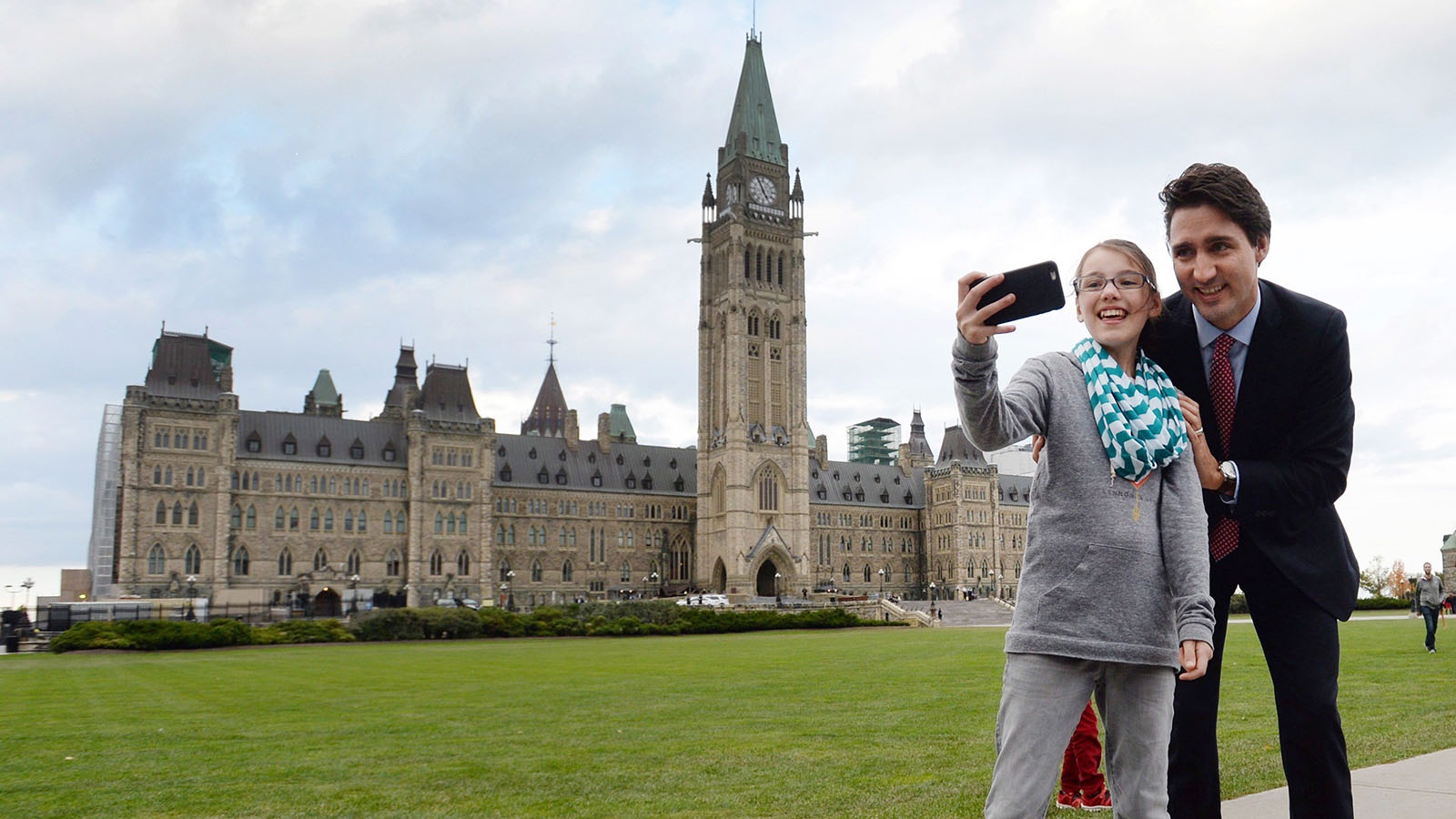
In New York, there were the all-too frequent pretentious statements: "Today, with my signature, I give you our word that Canada's efforts will not cease."
And just to prove that he is a self-styled world leader in this area, Trudeau added: "Climate change will test our intelligence, our compassion and our will. But we are equal to that challenge. I encourage other signatories to move swiftly to follow through on their commitments."
Smiling generalized speeches are good for the ego and opinion polls, but Trudeau should be using his powerful position to motivate Canadians to take part in a massive national campaign to tackle global warming.
But while critics say much of Canada's non-renewables must be left in the ground if we hope to meet our emission targets, Trudeau refuses to take a firm stand either way. Questioned by reporters at the Liberal Party retreat in Alberta last week, Trudeau said he would not comment on a "hypothetical" new route for Gateway but stated "the Great Bear rainforest is no place for a ... crude pipeline."
Meanwhile, Canadians continue to pollute the atmosphere at a record pace.
28 Apr 2016
2 Feb 2016
MEDIA IN CRISIS - 1:
Why feds should step in to
help democracy's watchdogs
among people who are soon going to be dead."
-- John Miller
former senior editor at The Toronto Star
A flourishing, capable news media is the oxygen of democracy. In Canada, our traditional oxygen-providers, the mainstream corporate-owned newspapers, are dying. We need to come up with something better to serve our communities.
Since the beginning of the year, we’ve seen papers in Vancouver, Calgary, Edmonton, and Ottawa bizarrely merged; a potentially disastrous strike in Halifax. The Guelph Mercury’s last print edition. The closure of The Toronto’ Star’s printing press, and gradual shaving back at every paper in the country.
Not all papers are losing money, but none is flourishing. And none still provides the scope or depth of balanced news essential to a citizenry that wants to be engaged.
How has this happened?
MEDIA IN CRISIS - 2:
Citizens, government need to plan now to have quality media in future
Canada’s mainstream media are in a state of incipient meltdown. They no longer deliver the volume or quality of news that Canadians need to be informed about important happenings in their communities, let alone to participate in a healthy democratic process.
The corporations that own traditional newspapers, seeing their revenues and readership dissolve, have opted to cut jobs and slash the content that used to provide their product’s value.
This is a serious problem for the way our democracy is supposed to work, and it is not going away.
It is time for governments—federal, provincial, and municipal—to step up and find a way to make sure that Canadian communities once again receive the news and information they need to function properly.
I explained in an earlier column why it would be the wrong choice for governments to support the same media that are failing under profit-driven corporate ownership.
Instead, the best solution to our growing news crisis is for governments to provide the financial support needed so that community-based Internet news sites will be sustainable.
Finding government money for public interest news shouldn’t be a problem. Governments already spend millions of dollars to support the diversity of Canadian magazines, privately owned TV stations, and, of course, the CBC.
We also all need to recognize that the transition to Internet-based delivery for disseminating news and information is only accelerating, will soon be virtually complete.
Instead of thinking about the way news dissemination is now, with newspapers hanging on, we need to envision what conditions will be like in, say 10 years, and begin working toward that time frame now.
How? Here’s what I’d like to see happen.
The corporations that own traditional newspapers, seeing their revenues and readership dissolve, have opted to cut jobs and slash the content that used to provide their product’s value.
![]() |
| News on the Internet: Everyone will get in on the act! |
This is a serious problem for the way our democracy is supposed to work, and it is not going away.
It is time for governments—federal, provincial, and municipal—to step up and find a way to make sure that Canadian communities once again receive the news and information they need to function properly.
I explained in an earlier column why it would be the wrong choice for governments to support the same media that are failing under profit-driven corporate ownership.
Instead, the best solution to our growing news crisis is for governments to provide the financial support needed so that community-based Internet news sites will be sustainable.
Finding government money for public interest news shouldn’t be a problem. Governments already spend millions of dollars to support the diversity of Canadian magazines, privately owned TV stations, and, of course, the CBC.
We also all need to recognize that the transition to Internet-based delivery for disseminating news and information is only accelerating, will soon be virtually complete.
Instead of thinking about the way news dissemination is now, with newspapers hanging on, we need to envision what conditions will be like in, say 10 years, and begin working toward that time frame now.
How? Here’s what I’d like to see happen.
20 Jan 2016
Don't weep for censoring, right-wing
Postmedia newspapers
Another 90 dedicated journalists in Vancouver, Calgary, Edmonton and Ottawa lost their jobs Tuesday as cutthroat Publisher Paul Godfrey slashed away again in an effort to turn Postmedia into a profit-making business.
In a bizarre move, two competing papers will continue to be separate entities, but there will be one set of editors and most journalists will be shared.
In Vancouver, the Sun and The Province will come under one roof. In Edmonton, the Journal and the Sun will come together; in Calgary, the Calgary Herald and the Sun; and in Ottawa, The Ottawa Citizen and the Sun.
This latest maneuver, in effect, reduces the four cities to print media monopolies. Even as weak as the original Postmedia and Sun papers were, they still competed with each other. Now the same editors will assign reporters from both papers.
In a bizarre move, two competing papers will continue to be separate entities, but there will be one set of editors and most journalists will be shared.
![]() |
| Paul Godfrey - CEO Postmedia Corp |
This latest maneuver, in effect, reduces the four cities to print media monopolies. Even as weak as the original Postmedia and Sun papers were, they still competed with each other. Now the same editors will assign reporters from both papers.
10 Jan 2016
Struggling to manage your life?
Our destructive system is likely to blame.
I was dismayed by the comments of two women on CBC Toronto’s Metro Morning recently. The program deserves credit for planning throughout the week to deal with issues of stress and the fact that most people don’t have enough hours in the day to deal with important, often crucial, matters.
The two women were picked at random on the streets of downtown Toronto. They told the CBC horrendous stories about how difficult their lives are – from being unable to meet the needs of their children, to too much stress at work, not enough money for childcare, and having no time to themselves.
How serious is the problem? A poll conducted for the Heart and Stroke Foundation revealed that half those interviewed were unhealthy because of their lifestyle:
The two women were picked at random on the streets of downtown Toronto. They told the CBC horrendous stories about how difficult their lives are – from being unable to meet the needs of their children, to too much stress at work, not enough money for childcare, and having no time to themselves.
But, if like the two women, you’re under too much pressure in your life and you don’t have any free time, keep in mind it’s happening to just about everyone, and it’s not your fault. It has to do with the way the economic system we live under us putting the squeeze on most of us.
How serious is the problem? A poll conducted for the Heart and Stroke Foundation revealed that half those interviewed were unhealthy because of their lifestyle:
- 44% of respondents said they had no time for regular physical activity.
- 41% said healthy meals take too long to prepare.
- More than half (51%) said fast food outlets don't have enough healthy choices.
- And almost a third (31%) said the time they would like to spend being active they instead spend commuting.
17 Dec 2015
Climate controls ‘slip slidin’ away’
following weak Paris agreement
“World agrees to historic climate accord”
The Toronto Star.
“Nearly 200 countries agree to historic pact in Paris
to reduce emissions and fight climate change”
The Vancouver Sun.
to reduce emissions and fight climate change”
The Vancouver Sun.
“Climate deal: World praises France's diplomacy, showing it's still a master of the art”
The Winnipeg Free Press.
Unfortunately, this assumption couldn’t be further from the truth.
The politicians meeting in Paris, faced with the possibility of total failure, were extremely excited to reach any kind of an agreement. As politicians will do, they convinced themselves and the compliant mainstream media that the accord all 195 countries signed was an amazing break through document.
The agreement is jam-packed with lofty language and idealistic goals. However, it is totally lacking in legally binding mechanism that will hold governments to emission limits that will stop global warming from reaching devastatingly high levels.
May & Klein have strongly different opinions
Even so, there are strong differences of opinion among environmental leaders concerning the value of the pact.
Green Party leader Elizabeth May is not concerned that the temperature goals in the agreement are not binding.
“It’s an historic and potentially life-saving agreement,” May writes in her blog. . . . . “it may save the lives of millions. It may lead to the survival of many small nations close to sea level. It may give our grandchildren a far more stable climate and thus a more prosperous and healthy society.”
Two of the world’s leading climate activists disagree strongly with May.
Responding to the cheering going on in the meeting room when the deal was signed, Bill McKibben, co-founder of 350.org commented: “All the serious people in there in suits are playing fantasy games.”
Activist and author Naomi Klein said the agreed upon targets are far too weak. “They don’t lead us to 1.5 degrees Celsius or 2 degrees. They lead us to warming of 3 to 4 degrees Celsius, which is beyond catastrophic.”
26 Nov 2015
Fossil fuel lobby seen as main threat
to meaningful progress in Paris
In the early-1950s, when it became widely known that smoking caused cancer, giant tobacco companies formed the Tobacco
Industry Research Council (TIRC). Its main goal was to deny the harmful effects
of tobacco and confuse the public.
The tobacco lobby wormed its way into the United Nations’
World Health Organization (WHO), wreaking havoc and slowing the WHO’s efforts to reduce the growing number of cancer deaths.
Realizing that the tobacco corporations were obstructing
progress, the WHO finally built a firewall between public health officials and industry
lobbyists. Only then was it possible to better control tobacco.
Flash forward to Paris and the 21st annual UN Climate Conference, November 30 to December 11 The 190 participating countries are charged with trying to hold carbon
emissions to liveable limits between the years 2020 and 2030.
But – just like when the tobacco lobby was powerful – the fossil
fuel lobby is strongly influencing decisions to be made in Paris.
Pointing to the struggling world economic situation, the
World Business Council for Sustainable Development (WBCSD) says
climate change is important, but it should not jeopardize economic growth.
15 Sept 2015
Can Mulcair work a miracle
and gain unlikely victory?
From the very start, the main issue in the federal election race has been as obvious as the beard on Tom Mulcair’s face, but it’s been largely ignored by mainstream media.
The big time journalists are rushing from the leaders’ pre-planned news conferences day after day, but the majority of voters have said in opinion polls that by far the biggest issue for them is to have either the NDP or Liberals emerge as the party that can soundly defeat Stephen Harper and the Conservatives.
During the fourth week of the campaign, it looked like the NDP might be the chosen party. They were at 33.9 per cent in the polls. The Conservatives were at 28.4 per cent, and the Liberals 27.9.
It looked like the NDP might jump to, say, 36 or 38 per cent in the polls and become the party to stop Harper. But it didn’t happen. Instead, the NDP fell back a little.
The NDP might be suffering because of Mulcair’s misguided promise to balance the budget. This is not playing well with Canadians who question how the NDP is going to both balance the budget and pay for all the promises they’ve made. Meanwhile, many progressives who believe the government should borrow to stimulate the economy – as Trudeau promised to do – are upset with the NDP for adopting an overly-cautious position.
If you believe Monday’s opinion polls, the NDP was at 31 per cent, and the Liberals and Conservatives tied at 30 per cent.
This week the NDP faces two big hurdles. On Wednesday, Mulcair will release figures showing how the party would pay for its election promises. And on Thursday he will join the other two leaders in a televised debate on the economy. If Mulcair survives the attacks he will face during Thursday’s debate, the NDP should still be in the race.
Some analysts have written off Harper – largely because they thought the Conservatives took a big hit during the frantic Syrian refugee acrimony. But in Monday’s Nanos Research poll, the Conservatives were back to 30 per cent.
The big time journalists are rushing from the leaders’ pre-planned news conferences day after day, but the majority of voters have said in opinion polls that by far the biggest issue for them is to have either the NDP or Liberals emerge as the party that can soundly defeat Stephen Harper and the Conservatives.
During the fourth week of the campaign, it looked like the NDP might be the chosen party. They were at 33.9 per cent in the polls. The Conservatives were at 28.4 per cent, and the Liberals 27.9.
It looked like the NDP might jump to, say, 36 or 38 per cent in the polls and become the party to stop Harper. But it didn’t happen. Instead, the NDP fell back a little.
The NDP might be suffering because of Mulcair’s misguided promise to balance the budget. This is not playing well with Canadians who question how the NDP is going to both balance the budget and pay for all the promises they’ve made. Meanwhile, many progressives who believe the government should borrow to stimulate the economy – as Trudeau promised to do – are upset with the NDP for adopting an overly-cautious position.
If you believe Monday’s opinion polls, the NDP was at 31 per cent, and the Liberals and Conservatives tied at 30 per cent.
This week the NDP faces two big hurdles. On Wednesday, Mulcair will release figures showing how the party would pay for its election promises. And on Thursday he will join the other two leaders in a televised debate on the economy. If Mulcair survives the attacks he will face during Thursday’s debate, the NDP should still be in the race.
Harper hopes ‘dirty tricks’ let him win
Some analysts have written off Harper – largely because they thought the Conservatives took a big hit during the frantic Syrian refugee acrimony. But in Monday’s Nanos Research poll, the Conservatives were back to 30 per cent.
2 Sept 2015
Strong voter registration campaign
could mean the end for Harper
The primary objective of Stephen Harper’s absurdly-named Fair Elections Act is to prevent hundreds-of-thousands of Canadians from voting for the NDP, Liberals, Greens, etc.
The Conservatives are, in effect, “cheating” the electoral process again, just as blatantly as in the past. They know that a large number of people – students, marginalized people and First Nations – will have a hard time voting because of the changes. And they know those people would not likely vote Conservative.
Even though the Conservatives are trailing in the polls, it’s much too soon to say they will lose the election. Harper’s gang of strategists and pollsters have masterminded their way to victory three times, overcoming tough odds each time.
But efforts to help people to register to vote are not as strong as they could be. There needs to be close co-operation among groups to make sure that as many people as possible – particularly people in some 70 ridings where the Conservatives are vulnerable – have the identification they need to vote.
The Council of Canadians contends that some 770,000 people may have a difficult time voting because of the changes to the Act. Included are 400,000 people who used the voter ID card in 2011 and believe that’s all they need this time; 250,000 people who will move during the election period; and 120,000 who used vouching in 2011.
The Conservatives are, in effect, “cheating” the electoral process again, just as blatantly as in the past. They know that a large number of people – students, marginalized people and First Nations – will have a hard time voting because of the changes. And they know those people would not likely vote Conservative.
Even though the Conservatives are trailing in the polls, it’s much too soon to say they will lose the election. Harper’s gang of strategists and pollsters have masterminded their way to victory three times, overcoming tough odds each time.
But efforts to help people to register to vote are not as strong as they could be. There needs to be close co-operation among groups to make sure that as many people as possible – particularly people in some 70 ridings where the Conservatives are vulnerable – have the identification they need to vote.
![]() |
| Alexie Stephens is one of Leadnow's staff members working to defeat the Conservatives. |
The Council of Canadians contends that some 770,000 people may have a difficult time voting because of the changes to the Act. Included are 400,000 people who used the voter ID card in 2011 and believe that’s all they need this time; 250,000 people who will move during the election period; and 120,000 who used vouching in 2011.
22 Jul 2015
Weak tactics, stupidity and lies cloud seriousness of climate change for Canadians
In addition to the staging of the PanAm Games, Toronto was the location of some unusually high profile activities in recent days that were supposed to increase the efforts to tackle climate change.
The events raised some important questions: How effective are efforts to slow the increase of carbon emissions into the atmosphere, do Canadians agree on the extent of damage to our environment, and what do scientists say in their most recent reports about the degree of the threat?
Celebrities lead ‘the big protest: First, Toronto had the spectacle of actor/activist Jane Fonda, environmentalist David Suzuki and author-activist Naomi Klein leading a march of some 12,000 protesters belonging to a new coalition through downtown streets. From all accounts, they were a cheerful bunch.
Subscribe to:
Posts (Atom)


